

Profiles of alumnae

Katerina Yakimova
Katerina Yakimova, originally from Bulgaria, studies in Scotland and joined CRC SynTrac in July 2024 for her Master thesis research. In SynTrac, her work is part of Project B04.
Born and raised in Bulgaria, Katerina attended the American College of Sofia and created an opportunity for herself to finish her high school education at a boarding school in Scotland. This experience not only broadened her horizons but also instilled in her a deep sense of independence, drive, and curiosity.
After graduation, she enrolled in MEng Aeronautical Engineering at the University of Glasgow. Known for its rigorous curriculum and cutting-edge research opportunities, the program has been a perfect fit for her drive to excel in a challenging field.
While planning the topic of her Master thesis, Katerina was keen on doing an external placement at a university outside of the UK and focused on Germany and France as potential locations, recognising their strong reputation for engineering excellence and innovation in aviation. During her search, she came across the SynTrac project online. Intrigued by its multidisciplinary approach and relevance to climate-neutral technologies, she took the initiative to apply at the University of Stuttgart. Her main interest is in the area of propulsion which aligned with the goals of project B04. As part of SynTrac, Katerina works on research related to exhaust gas treatment of turbofan, specifically looking into the potential of water recovery as a viable solution to the reduction of contrail formation, and thus, contributing to the drive for a sustainable future of aviation.
Her journey reflects not only her technical mindset, but also her personal ambition to make a meaningful impact in the field of aerospace engineering.
“Propulsion systems are my main area of interest, and I was able to focus on this in my SynTrac related research in a well organised work environment with a welcoming, supportive team!”
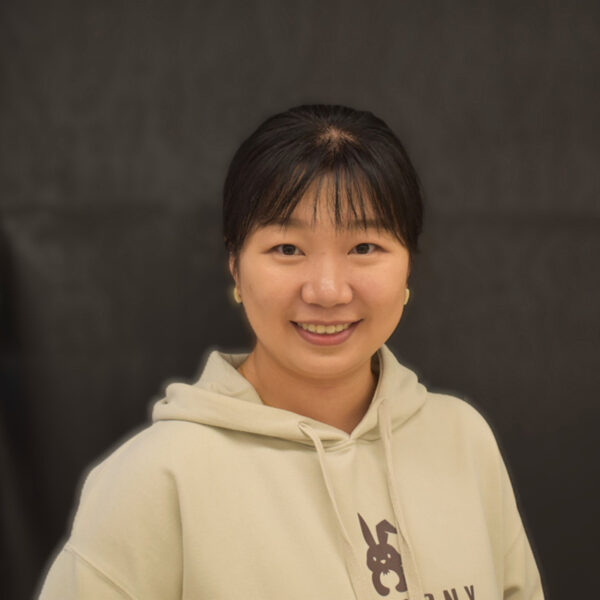
Qi Qi
Qi Qi is from China and joined the SynTrac CRC in November 2023 for a Research Internship. In SynTrac, her work is associated with project B01.
She obtained a Bachelor degree from Northwest Polytechnical University in Xi’an CHINA before she moved to Germany to start a Master’s degree at the University of Stuttgart. After successfully completing her Master’s Degree, she continued her research as part of the International Female Program in the SynTrac CRC at the Institute of Aircraft Propulsion Systems at the University of Stuttgart. While her motivation to study abroad is fueled by a general curiosity to see the world, her decision to choose Germany as a destination has been deliberate. She has a high regard for the standard of education at German universities and appreciates the strong links between the research community and industry.
Steadily developing her research profile, she moved from studying heat transfer with numerical methods to exclusively experimental approaches, continuously expanding her understanding of the flow of particles. Her current project in SynTrac focuses on the rebound of particles in the environment of the turbomachinery of an aircraft.
“When looking at a particular research question, there are usually many factors at play and finding the ´one true signal´ or pattern that advances our understanding is one of the exciting aspects of my work.”
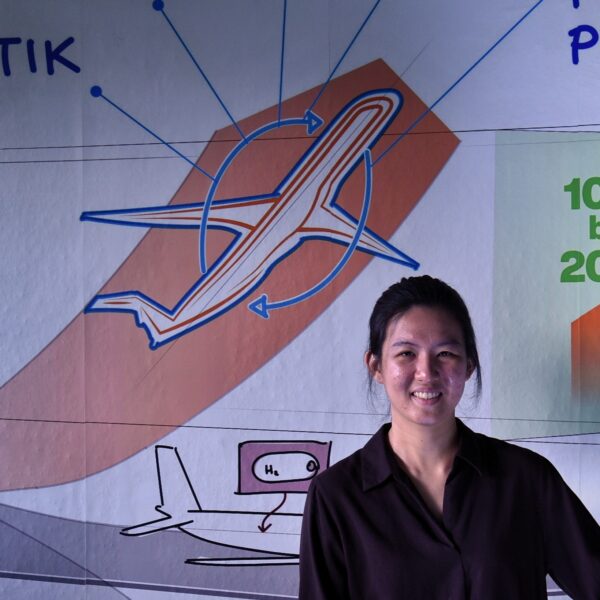
Kai Xin Lum
Kai Xin Lum is from Malaysia and joined SynTrac for her Master’s Thesis Research in April 2025. In SynTrac, her work is associated with sub-project B04.
After commencing engineering studies at the National University of Malaysia (UKM) through the long-standing 3+1 Double Degree Program with Universität Duisburg-Essen (UDE), Kai moved to Germany to complete her final year, including two semesters and her Bachelor’s thesis at UDE. Inspired by the experience, she continued her academic journey by pursuing a Master’s degree in Energy and Environmental Engineering at UDE.
Kai’s main research interest lays in multiphase and particle-laden flows in turbomachinery applications. In aircraft engines, ingested particles can collide with blades, causing erosion and performance deterioration. To improve erosion prediction accuracy, her work centers on developing particle fragmentation algorithms and implementing them in CFD simulations to better capture particle behavior after fracture.
A part of completing her Master’s degree, she joined SynTrac for 6 months to conduct research required for her thesis. Associated with sub-project project B04 her research focuses on thrust vectoring control and nozzle deflection modeling in CFD using mesh morphing techniques to investigate their influence on fluid flow.
“I am still amazed every time I think about how these massive metal machines can carry people through the sky from one place to another. Having the opportunity to conduct research on propulsion systems truly feels like a dream come true for me.”